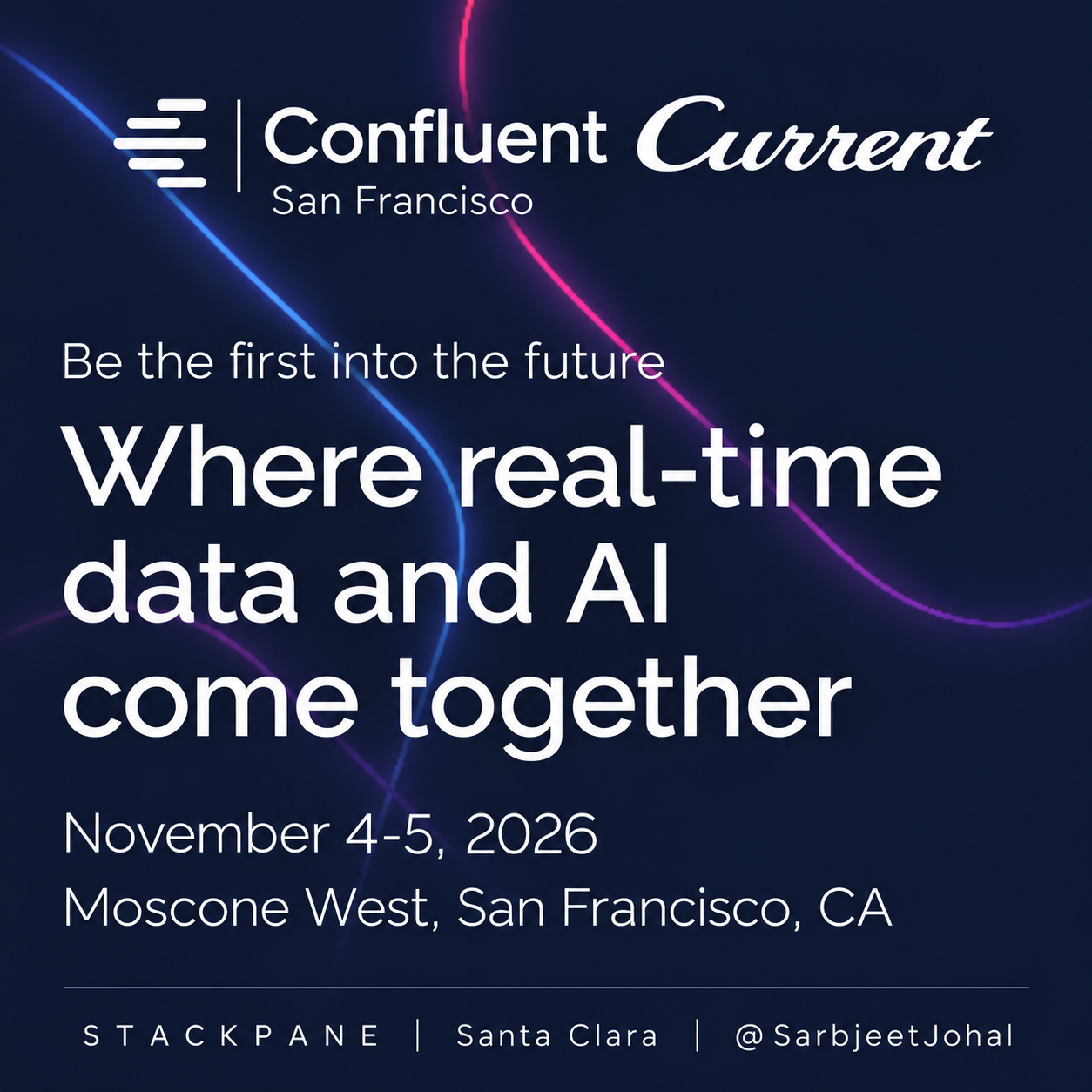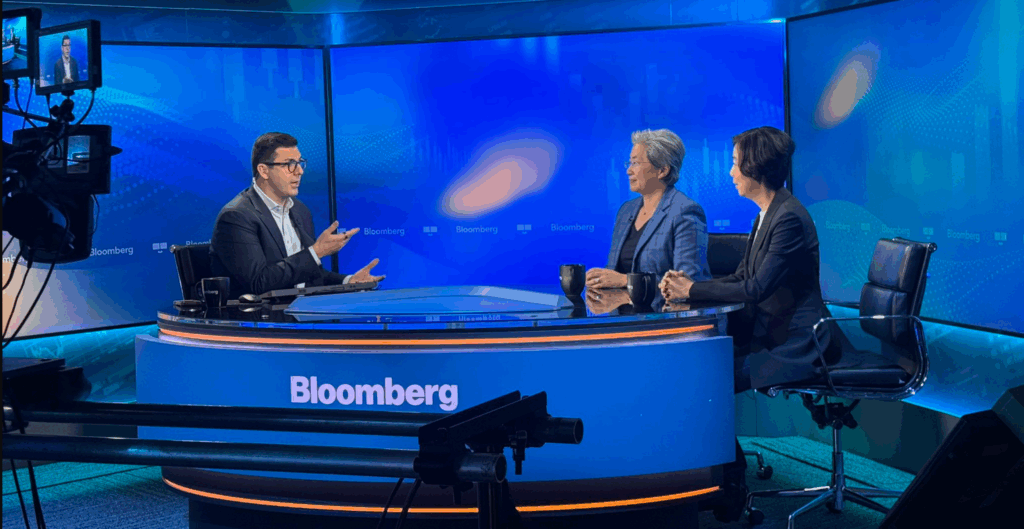
Confluent Current — Nov 4–5, 2026, San Francisco

This year’s conference is uniquely shaped by IBM’s $11 billion acquisition of Confluent, which officially closed on March 17, 2026, to feed real-time, trusted data into enterprise AI models

Core Technological & AI Themes

The programming across the 2026 events emphasizes that traditional batch processing and data warehouses are too slow for probabilistic AI models, which require real-time context to remain statistically accurate and safe.

  • Real-Time Context Engineering: The main keynotes emphasize building data pipelines that deliver real-time operational context to AI systems. This process ensures AI agents don’t require broad, unsafe access to raw company directories.
  • Agentic AI built on Apache Flink: Sessions dive deeply into utilizing Apache Flink for unified stream and batch processing, enabling autonomous AI agents to make decisions and execute actions directly on live event streams.
  • Tableflow Innovations: Confluent is highlighting its Tableflow functionality, which effortlessly materializes streaming topics into cloud object storage tables using formats like Apache Iceberg and Delta, bridging the gap between operational streaming and analytical data lakes.
  • Expanding Community Scope: While Apache Kafka remains the fundamental core, the community has explicitly expanded to include AI engineers and application developers who design real-time intelligent software.
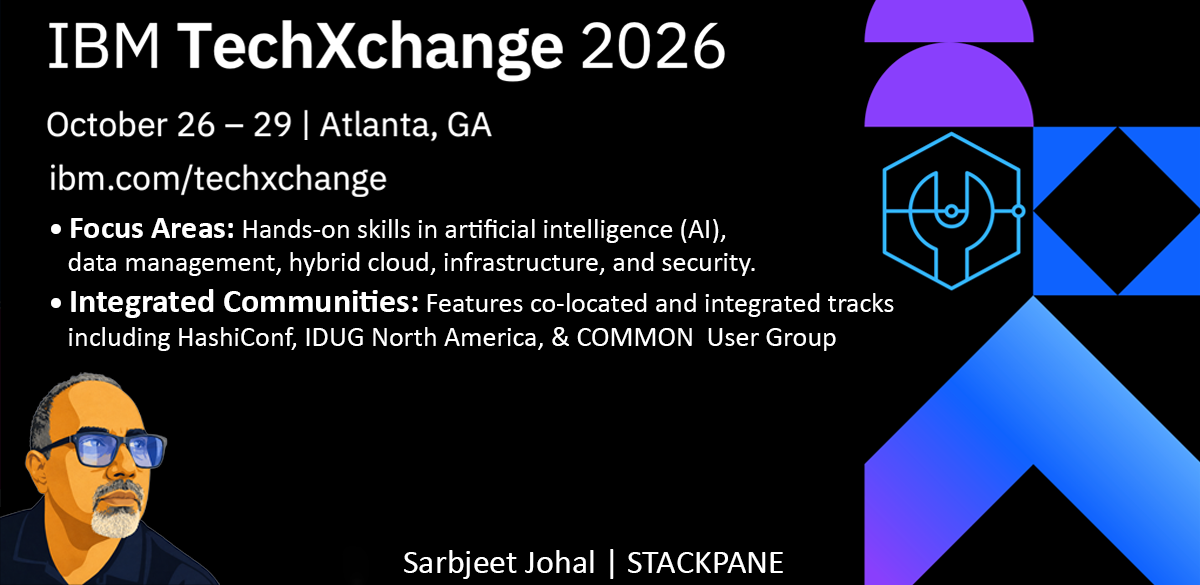
IBM TechXchange 2026, Atlanta

IBM TechXchane 2026, Oct 26-29, Atlanta

LOCATION: Georgia World Congress Center in Atlanta, Georgia, USA

IBM TechXchange 2026 will run from October 26–29, 2026, at the Georgia World Congress Center in Atlanta, GA, offering four days of hands‑on learning, workshops, certifications, and community events across AI, cloud, data, infrastructure, and security.

Notable Speakers

Highlights include:

  • Dinesh Nirmal – SVP, Software, IBM

  • Garrett Rowe – CEO, NeuralSeek

  • Suman Devarasetti – VP, AI Enablement & Payments, BANCORP

  • Chris Wright – CTO, Red Hat

  • Rodney Mullen – Skater, entrepreneur

  • Tim O’Reilly – CEO, O’Reilly Media

  • Bill Higgins – VP, AI Developer Relations, IBM

Event Focus

This event focuses on building real‑world skills in:

  • AI applications (watsonx AI, intelligent agents, automation)

  • Data management (integration, governance, trusted data for AI/analytics)

  • Hybrid cloud management (IBM Cloud, Red Hat, DevOps, SRE)

  • Infrastructure (IBM Z, LinuxONE, Power, Storage)

  • Security & governance (data protection, compliance, “secure by default”

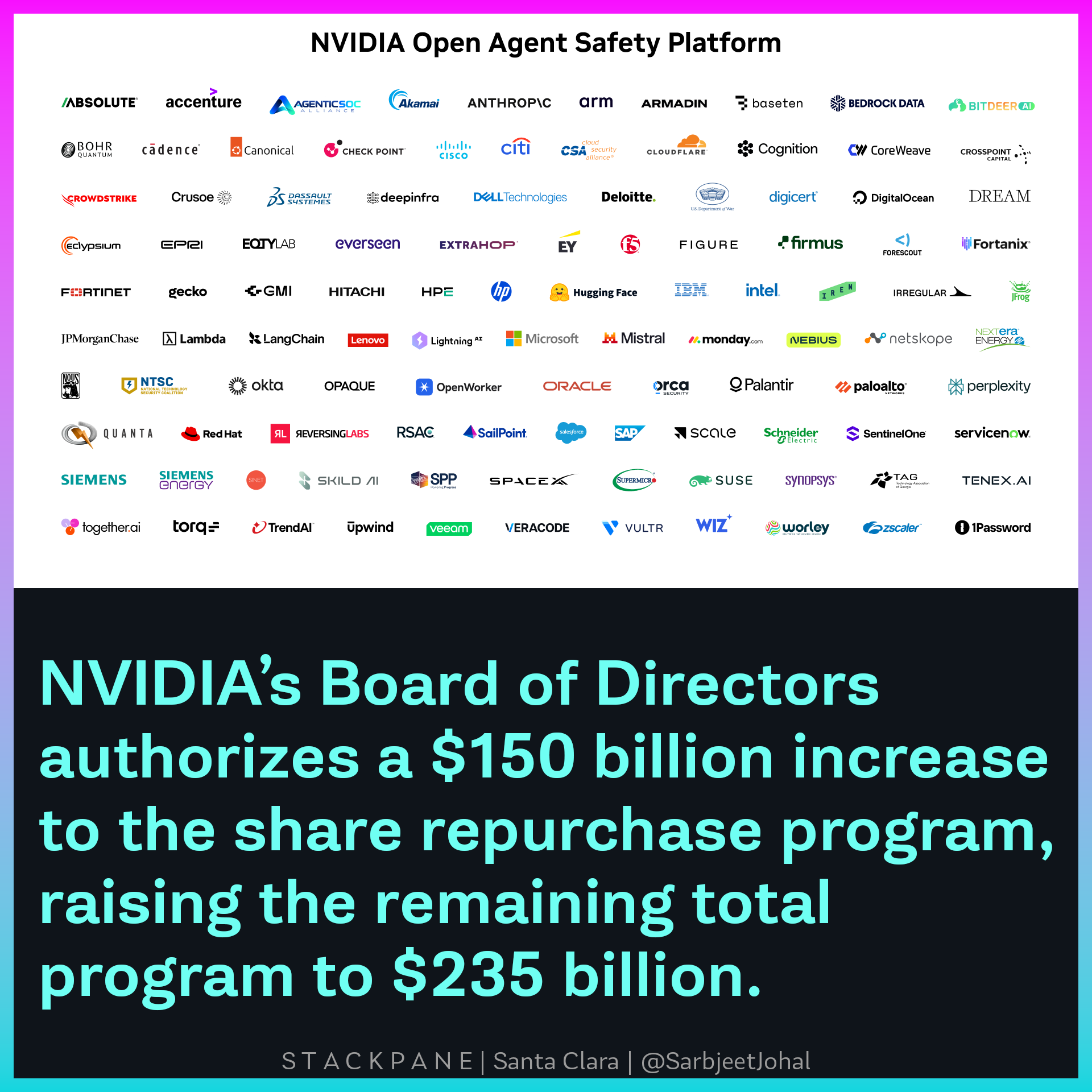
Nvidia announces Open Agent Safety Platform & $150 billion buyback addition.

There were two major, industry impacting announcements made by Nvidia in last 24 hours. One was the announcement of $150 billion boost for shares buyback program (a record), and the other one is announcement of Open Agent Safety Platform with several partners behind it (including Anthropic.

My POV. Announced on September 28, Open Agent Safety Platform is a master stroke in GTM strategy. Amidst (AI security related) high tensions in the market, Nvidia announcing this program shows the position Nvidia is in and how high the stakes are. It’s clear that this step will strengthen Nvidia’s moat further.

NVIDIA Open Agent Safety Platform consists of NVIDIA OpenShell open source software and the NVIDIA Sentry reference system design that enables full-stack governance and control across software and the hardware, compute and robotics systems that run agents.

More on Open Agent Safety Platform here: https://nvidianews.nvidia.com/news/open-agent-safety-platform

More on shares buyback program (announced on September 28) here: https://nvidianews.nvidia.com/news/nvidia-announces-a-150-billion-share-repurchase-authorization-increase

Third big AI related news coming for m Silicon Valley was AMD acquiring World Labs for $8.2 Billion.

AMD is acquiring Fei-Fei Li’s World Labs in an $8.2 billion

AMD is acquiring Fei-Fei Li’s World Labs in an $8.2 billion, all-stock deal. Dr. Li joins AMD as EVP/Chief Scientist.

My POV: it’s a great move by AMD as they need AI research and software chips to push their platform to the market. Dr. Li’s reputation will give a big boost to AMD platform in research and frontier labs space.

Akamai Announces $11.6 Billion Multi-year Agreement with Anthropic

On September 24, Akamai Technologies signed a seven-year, $11.6 billion cloud computing agreement with @AnthropicAI to support the AI company’s growing CPU workload requirements.

Deal Highlights

Total Value: $11.6 billion guaranteed over seven years, with an option to expand by another $9 billion (pushing the potential total to $20 billion).

Equity Stake: Akamai Technologies issued a warrant giving Anthropic up to a 5% stake in its common stock, with vesting milestones tied directly to contract expansion and cloud service purchases.

Capital Expenditures: Akamai expects to spend roughly $5.5 billion in CapEx to build out capacity, including $1.7 billion toward late-2026 supply chain pre-purchases (such as memory).

Revenue Projections: Akamai expects $150 million to $300 million in revenue from the contract in late 2027, scaling to an annualized run rate of $1.7 billion by the end of 2028.

More on the deal from Akamai newsroom: https://www.akamai.com/newsroom/press-release/akamai-announces-11-6-billion-multi-year-agreement-with-anthropic-to-support-growing-demand

Sarbjeet Johal on Open Source AI and Cloud Economics | theCUBE + NYSE Wired

Where is AI creating lasting value—and who is positioned to capture it? In this conversation from theCUBE + NYSE Wired: Mixture of Experts, StackPane founder Sarbjeet Johal joins John Furrier to explore the connections between open source, global AI adoption, and the economics of AI infrastructure.

Open source and the global AI economy

Johal discusses how open source and open-weight models can expand access to AI beyond the largest technology companies. The conversation considers NVIDIA’s role in the open source ecosystem, the opportunities for developing nations and local data centers, and the pressures automation places on systems integrators.

Coding agents are another focus. Johal connects their importance to the broader work of digitizing industries, including healthcare, transportation, and infrastructure.

The economics behind AI infrastructure

The discussion also examines neoclouds and the factors that shape their businesses: token output, operating costs, and power efficiency. Johal and Furrier explore how these considerations affect emerging infrastructure providers such as CoreWeave.

They round out the conversation with the competition for AI talent, differing paths to public markets, and the partnerships established software companies are using to respond to AI disruption.

Explore the conversation

Video published by SiliconANGLE theCUBE on September 1, 2026. Watch the original interview on YouTube.

Open-Weight AI Models: Costs, Continuity, and Enterprise Risk, with Efi Pylarinou

What does access to model weights mean for an enterprise that needs dependable AI? Sarbjeet Johal joins Dr. Efi Pylarinou on Fintech Conversations & Insights to discuss the practical economics and operational risks of open-weight models.

Ownership and operational continuity

The conversation distinguishes open-weight models from open source and examines the infrastructure needed to run them. Johal explores why possessing model weights does not, by itself, resolve questions of continuity, backward compatibility, or long-term business dependence.

Matching models to enterprise requirements

Johal and Pylarinou discuss model routing, experimentation, and the different requirements of startups and established enterprises. They also consider why systems of record and systems of engagement place different demands on AI accuracy and consistency.

The next enterprise AI architecture

The discussion looks ahead to specialized models, independent software vendors, and composite systems. It connects those possibilities with the continuing role of developers and the opportunity to make AI more broadly accessible.

Explore the conversation

Video published on YouTube on September 2, 2026, was recorded on August 25, 2026. Watch the original conversation on YouTube.

AMD Advancing AI 2026 with Dave Vellante and Bob O’Donnell – San Francisco

What will it take for AMD to compete across the full AI infrastructure stack? At AMD Advancing AI 2026 in San Francisco, StackPane’s Sarbjeet Johal and TECHnalysis president Bob O’Donnell join theCUBE’s Dave Vellante to examine AMD’s strategy, the evolving software ecosystem, and the opportunities for enterprise AI.

AMD’s push toward a complete AI platform

The panel discusses AMD’s Helios platform, the importance of rack engineering, and the partnerships shaping its AI ambitions. Johal frames the keynote around accelerators, the CPU opportunity, and relationships with companies including OpenAI, Anthropic, and Cerebras. O’Donnell considers how the combination of Helios and ZT Systems’ engineering strengthens AMD’s competitive position.

Software remains central to the competition

The conversation examines NVIDIA’s CUDA ecosystem and the progress of AMD’s ROCm software. Johal highlights the depth of NVIDIA’s libraries while the panel explores how model porting and tools such as Triton could influence adoption. For enterprises, the discussion connects hardware choice with the software and engineering needed to put it to work.

Hybrid AI and the future of enterprise computing

Johal, O’Donnell, and Vellante also explore the relationship between established x86 workloads and accelerated computing. They consider how on-premises deployments, client devices, and local inference fit into hybrid AI architectures—and how these choices could affect cloud token costs. AMD’s alliance with Cisco adds another dimension to the discussion of managing distributed AI infrastructure.

The recurring theme is the value of competition: a broader set of credible platforms gives customers more options as they combine existing enterprise systems with new AI capabilities.

Explore the conversation

Video published by SiliconANGLE theCUBE on July 23, 2026. Watch the original panel on YouTube.

Agentic Runtime Security | Suja Viswesan and Sarbjeet Johal at IBM Think 2026

How should security change when software agents can act on behalf of people? In this conversation from IBM Think 2026, Sarbjeet Johal speaks with IBM’s Suja Viswesan about securing agentic AI at runtime.

Identity, access, and accountability for agents

The discussion examines why controls designed for human users may need to evolve for agents. Topics include traceability, accountability, agentic identity and access management, and the risks of accumulating access or escalating privileges.

Security throughout an agent’s operation

Johal and Viswesan explore the distinction between runtime security and design-time security, as well as the relationship between human and agent privileges. They also discuss retaining context while managing permissions, the implications of composite applications, and security across products and vendors.

Explore the conversation

Video published on YouTube on June 25, 2026. Watch the original conversation on YouTube.

Cisco Live 26: Customer Experience, AI & Resilient Operations | Eric Knipp & Sarbjeet Johal

At Cisco Live 2026, Sarbjeet Johal speaks with Eric Knipp, Cisco’s SVP and General Manager of Customer Experience, about the announcements shaping Cisco’s customer experience business and the work of bringing new capabilities into production.

Customer experience, security, and partner services

The discussion explores Cisco’s customer experience philosophy, Cisco IQ, and Cisco Cloud Control. Johal and Knipp also examine the connections between security and customer experience, the role of professional services, and how playbooks and APIs can support partners.

From automation to resilient operations

The conversation turns to practitioner training, network as code, and the relationship between agentic AI, APIs, and automation. Digital twins and systems economics round out the discussion, connecting technical capabilities with operational resilience and the journey from planning to production.

Explore the conversation

Video published on YouTube on June 13, 2026. Watch the original conversation on YouTube.