What Tech Leaders said in last 10 days

AI is reshaping the technology industry, but the questions facing its leaders go well beyond model performance. How much infrastructure should companies build? Who will own enterprise intelligence? How will AI agents change software, security, and the way people work? This selection of interviews, published October 20–30, 2026, brings together perspectives from leaders at AWS, Microsoft, Amazon, NVIDIA, IBM, Palo Alto Networks, OpenAI, and Google. The conversations offer a useful view of where these companies are placing their bets—and the practical and economic challenges ahead.
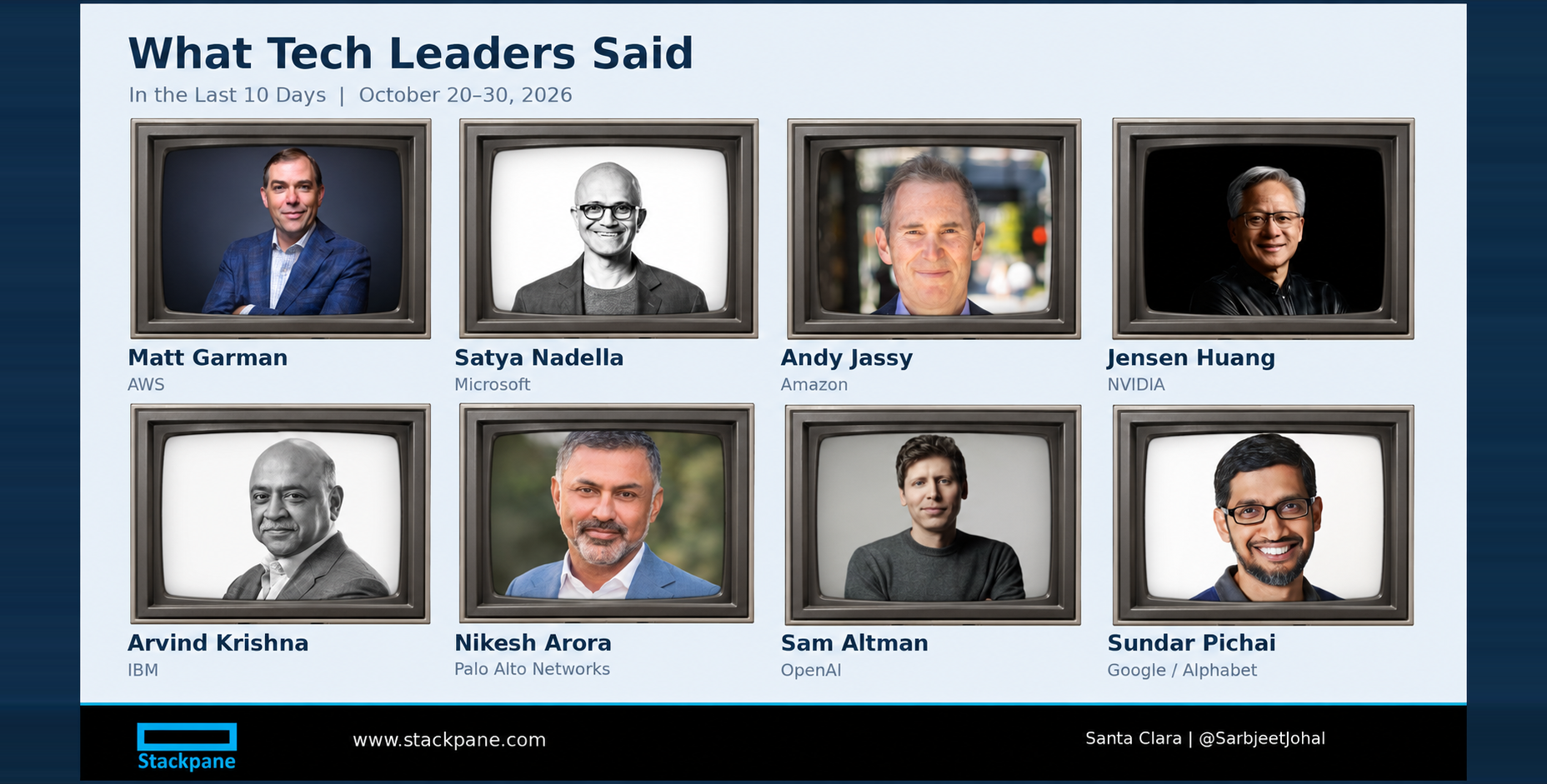
Eight tech leaders featured in Stackpane's What Tech Leaders Said roundup, wide landscape format

Oct. 30, 2026 – Matt Garman — AWS – Bloomberg Tech / Ed Ludlow

Main topics: Cloud growth, AI demand, and funding infrastructure expansion.

YouTube link: Watch on YouTube

Oct. 26, 2026 – Satya Nadella — Microsoft – 20VC / Harry Stebbings

Main topics: Open versus closed models, trusting AI agents, owning enterprise intelligence, and AI economics.

YouTube link: Watch on YouTube

Oct. 23, 2026 – Andy Jassy — Amazon – a16z / Ben Horowitz and Erik Torenberg

Main topics: AI infrastructure investment, AWS’s growth potential, inference costs, and AI’s impact on Amazon’s operations.

YouTube link: Watch on YouTube

Oct. 21, 2026 – Jensen Huang — NVIDIA GTC Berlin Keynote

Main topics: AI infrastructure demand, neoclouds, investment spending, and Europe’s AI opportunity.

YouTube link: Watch on YouTube

Oct. 21, 2026 – Arvind Krishna — IBM & Nikesh Arora — Palo Alto Networks – All-In

Main topics: Quantum threats to encryption, open-weight versus frontier AI, cyber warfare, and software consolidation.

YouTube link: Watch on YouTube

Oct. 21, 2026 – Sam Altman — OpenAI – Matthew Berman

Main topics: Recursive self-improvement, AI consciousness, scientific discovery, personal assistants, and hardware ambitions.

YouTube link: Watch on YouTube

Oct. 21, 2026 – Sundar Pichai — Google / Alphabet – Sources / Alex Heath

Main topics: Gemini, DeepMind leadership, compute shortages, AI infrastructure spending, personal agents, Waymo, and quantum computing.

YouTube link: Watch on YouTube

Oct. 20, 2026 – Sundar Pichai — Google / Alphabet – Big Technology / Alex Kantrowitz

Main topics: Competition with OpenAI, compute allocation between AI research and Cloud customers, AI agents, monetization, and Apple/Anthropic partnerships.

YouTube link: Watch on YouTube
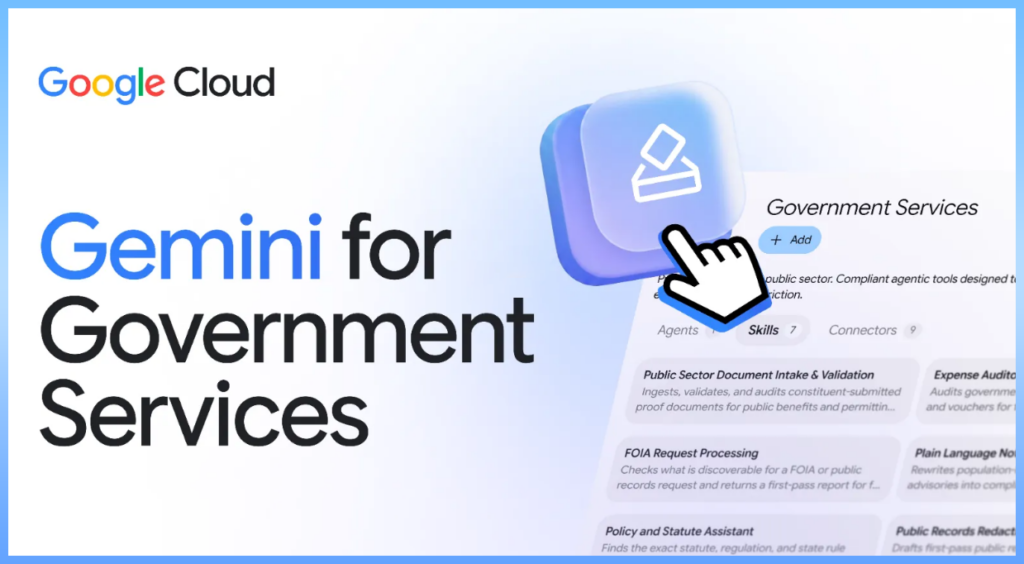
Google Brings Gemini Agents to Government Workflows

Google Cloud has introduced Gemini for government services, now in preview, to help federal, state, and local agencies apply AI to everyday operations. The focus is on work shaped by regulations, sensitive information, legacy systems, and human accountability.

The offering combines government-specific instructions, connections to existing agency systems, partner-built agents, and centralized governance. Google says agencies can connect their systems without migrating data while preserving existing access permissions.

My take: The workflow is where AI earns its value

Government use cases are a useful test of enterprise AI because producing an answer is only one part of the job. That answer must reflect the applicable rules, respect access controls, cite supporting evidence, and fit an established approval process.

This announcement reinforces a broader shift I see across the industry: AI value increasingly comes from connecting models to institutional knowledge and operational systems. The model matters, but so do integration, information architecture, governance, and the people responsible for decisions.

From a systems economics perspective, agencies should measure the full cost of completing a task. A faster document review has limited value if employees spend the time saved correcting errors or checking unsupported conclusions.

The measures of success should include:

  • Service delivery: Shorter processing times and smaller backlogs.
  • Quality: Fewer errors, clearer explanations, and less rework.
  • Accountability: Traceable evidence and meaningful human oversight.
  • Economics: Lower cost per successfully completed case, including integration and review.

Because there is no one AI workload, there is no one KPI for AI. Government adoption will need to demonstrate value workflow by workflow. This preview gives Google an opportunity to show how governed agents can translate technical capability into better public service.

Where Google sees immediate applications

  • Policy research: Find answers grounded in regulations and agency guidance.
  • Public records requests: Locate and organize documents for Freedom of Information Act reviews.
  • Document redaction: Identify sensitive information and propose redactions for human approval.
  • Procurement: Evaluate vendor bids against requirements and document scoring.
  • Grant audits: Flag questionable expenses and missing documentation.
  • Application intake: Validate submitted documents and identify incomplete information.
  • Public communication: Turn complex guidance into plain-language notices.

The platform supports connections across Oracle, Salesforce, ServiceNow, Google Workspace, and Microsoft 365. Its security foundation includes an option to deploy within Google Cloud’s Assured Workloads FedRAMP High Data Boundary. Google also says agency information will not be used to train its foundation models without permission.

More from Google on this announcement here.

Why Domain-Specific AI Can Be Faster, Safer, and More Economical

I believe domain-specific AI will become better, safer, and more economical for the enterprise work it is designed to perform. That is why I have repeatedly praised Google’s focus on industry-specific AI.

At Gemini at Work on October 8, 2026, Thomas Kurian reinforced that direction. For me, the significance goes beyond another product announcement: it points to where enterprise AI can create lasting value. We had an  analysts Q&A session with Google execs after the announcement on October 8 which brought some additional clarity around the announcements. 

Google’s industry focus is taking shape

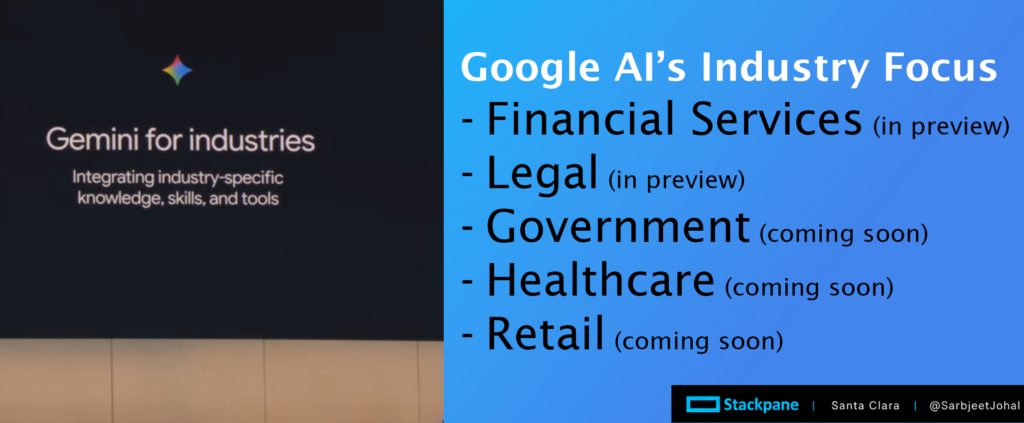
Google’s Gemini at Work announcement identifies Financial Services and Legal as in preview, with Government, Healthcare, and Retail coming soon. These are the availability labels announced at the event, rather than a claim that all five offerings are generally available.

The direction matters. Enterprise buyers need AI that understands the context of their work: its terminology, information sources, workflows, permissions, and standards of quality. A capable model is the starting point. Putting it to productive use requires the surrounding system.

The economic unit is a useful outcome

This is where systems economics becomes central. Token pricing alone does not tell an enterprise what AI costs. The full cost includes data preparation, integration, inference, review, rework, and ongoing operations. A cheaper response that requires repeated corrections may produce a more expensive workflow. A more capable system may justify its cost if it consistently reduces that work.

My preferred question: What does it cost to complete a useful, verifiable business task? Domain-specific AI earns its economic advantage when it improves that answer after the cost of specialization is included.

Why this matters for Google

I see Google’s combination of frontier-model development and hyperscale cloud delivery as a significant strategic advantage. An industry focus gives it a way to connect those capabilities to the environments where enterprise work happens.

The opportunity is to make more of the required infrastructure, integration, and workflow knowledge reusable across customers. Execution will determine how much of that opportunity becomes a practical advantage.

I have praised Google AI’s Industry/Vertical focus, repeatedly since they have announced it. In this week’s announcements, Thomas Kurian reiterated that focus with latest Gemini At Work announcements from Mountain View! 

This is Google’s huge differentiator as a Frontier Lab and a Hyper Scaler/Cloud Provider. I am sure that they will add more industries as time progresses, tech matures, and more industries come forward to collaborate.

Google AI’s Industry Focus (so far)

– Financial Services (in preview)

– Legal (in preview)

– Government (coming soon)

– Healthcare (coming soon)

– Retail (coming soon)

 My conviction remains: domain-specific AI can turn broad model capability into better enterprise outcomes. Its value will be proven through the quality, safety, and economics of the work it completes.

Adapted and expanded from my original LinkedIn post. Graphic reused from that post. Product availability references reflect Google’s October 8, 2026 announcement.

Nvidia announces Open Agent Safety Platform & $150 billion buyback addition.

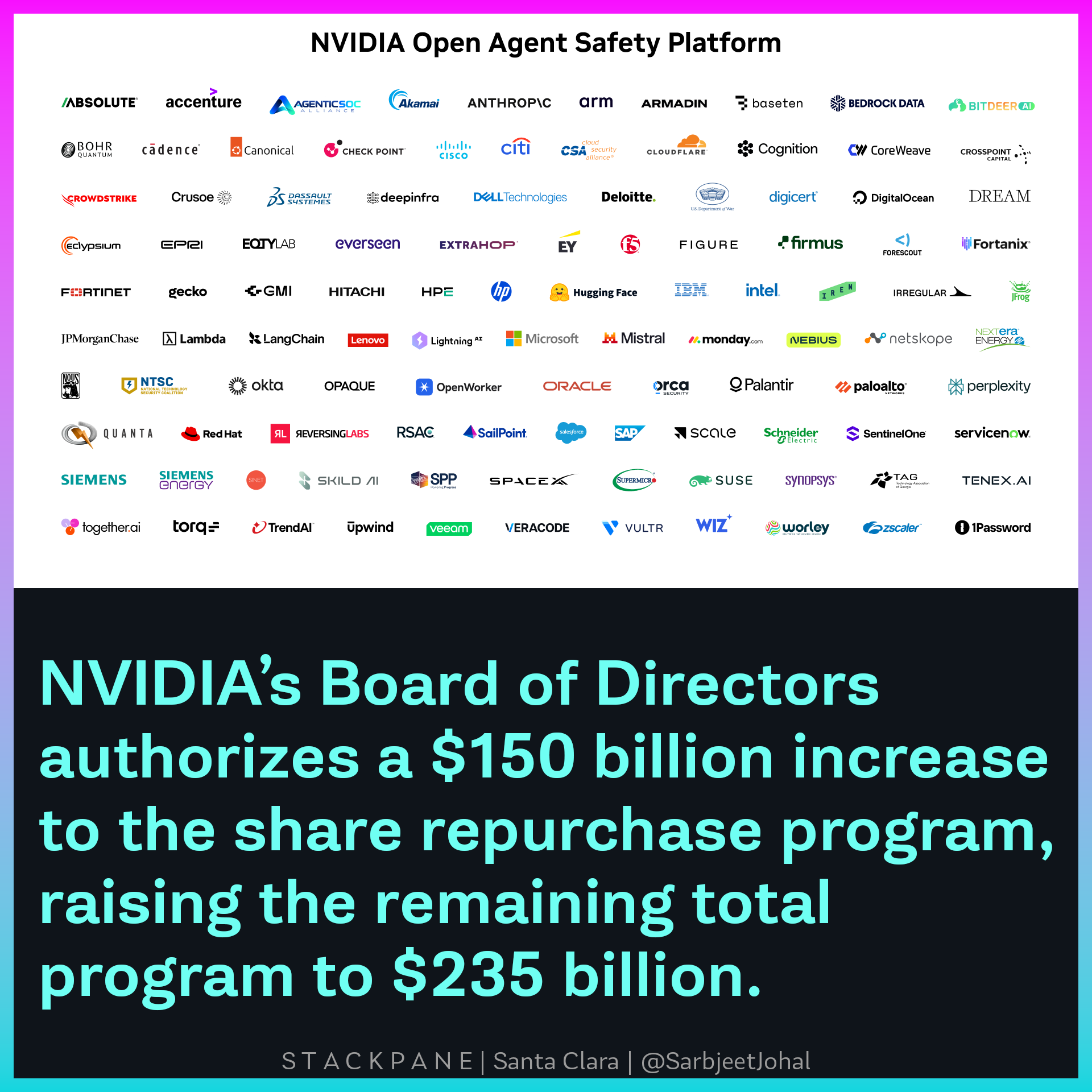
There were two major, industry impacting announcements made by Nvidia in last 24 hours. One was the announcement of $150 billion boost for shares buyback program (a record), and the other one is announcement of Open Agent Safety Platform with several partners behind it (including Anthropic.

My POV. Announced on September 28, Open Agent Safety Platform is a master stroke in GTM strategy. Amidst (AI security related) high tensions in the market, Nvidia announcing this program shows the position Nvidia is in and how high the stakes are. It’s clear that this step will strengthen Nvidia’s moat further.

NVIDIA Open Agent Safety Platform consists of NVIDIA OpenShell open source software and the NVIDIA Sentry reference system design that enables full-stack governance and control across software and the hardware, compute and robotics systems that run agents.

More on Open Agent Safety Platform here: https://nvidianews.nvidia.com/news/open-agent-safety-platform

More on shares buyback program (announced on September 28) here: https://nvidianews.nvidia.com/news/nvidia-announces-a-150-billion-share-repurchase-authorization-increase

Third big AI related news coming for m Silicon Valley was AMD acquiring World Labs for $8.2 Billion.

AMD is acquiring Fei-Fei Li’s World Labs in an $8.2 billion

AMD is acquiring Fei-Fei Li’s World Labs in an $8.2 billion, all-stock deal. Dr. Li joins AMD as EVP/Chief Scientist.

My POV: it’s a great move by AMD as they need AI research and software chips to push their platform to the market. Dr. Li’s reputation will give a big boost to AMD platform in research and frontier labs space.

Akamai Announces $11.6 Billion Multi-year Agreement with Anthropic

On September 24, Akamai Technologies signed a seven-year, $11.6 billion cloud computing agreement with @AnthropicAI to support the AI company’s growing CPU workload requirements.

Deal Highlights

Total Value: $11.6 billion guaranteed over seven years, with an option to expand by another $9 billion (pushing the potential total to $20 billion).

Equity Stake: Akamai Technologies issued a warrant giving Anthropic up to a 5% stake in its common stock, with vesting milestones tied directly to contract expansion and cloud service purchases.

Capital Expenditures: Akamai expects to spend roughly $5.5 billion in CapEx to build out capacity, including $1.7 billion toward late-2026 supply chain pre-purchases (such as memory).

Revenue Projections: Akamai expects $150 million to $300 million in revenue from the contract in late 2027, scaling to an annualized run rate of $1.7 billion by the end of 2028.

More on the deal from Akamai newsroom: https://www.akamai.com/newsroom/press-release/akamai-announces-11-6-billion-multi-year-agreement-with-anthropic-to-support-growing-demand

HashiCorp, IBM, and Infrastructure in the AI Era | Armon Dadgar at IBM TechXchange 2025

HashiCorp, IBM, and Infrastructure in the AI Era | Armon Dadgar at IBM TechXchange 2025

IBM TechXchange 2025 | October 6–9, 2025 | Orlando, Florida

During IBM TechXchange 2025, I sat down with HashiCorp CTO Armon Dadgar to discuss HashiCorp joining IBM and the changing nature of infrastructure in the AI era.

In my view, Armon’s thinking on the core tenets of infrastructure is spot on. Watch our conversation below.

The conversation

  • HashiCorp joining IBM.
  • The changing nature of infrastructure in the AI era.
  • The core infrastructure principles behind Armon’s thinking.

— Sarbjeet Johal, Stackpane

Originally shared on Sarbjeet Johal’s LinkedIn. Event dates: IBM TechXchange 2025.